Valuable Vintage Cameras: 10 Models Flippers Hunt For
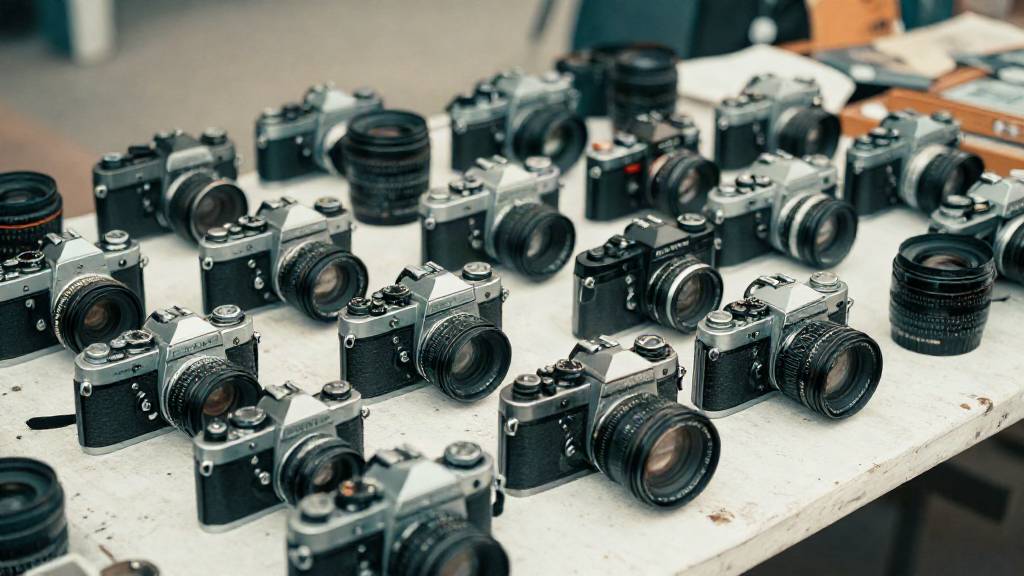
Somewhere on a table at your local flea market, there is a battered camera with a cracked leather strap and a price tag that says $12. It might be a $12 camera. It might be a $600 camera. The gap between those two outcomes almost never comes down to luck - it comes down to knowing which models collectors actually chase and which details move the price.
If you buy and resell, that gap is your entire margin. Here is what separates the valuable vintage cameras from the dust-collectors, the ten models worth memorizing, and how to check a price in seconds while the seller is still watching you.
What Actually Makes a Vintage Camera Valuable
Price is not one number - it is four numbers stacked on top of each other. Learn these levers and you can price almost anything on the table before you ask.
The brand and model
The same factory can produce a $40 camera and a $400 camera five years apart. Model matters more than brand. "Leica" gets you close; "Leica M3" gets you paid. Learn the exact model designations, not just the logos.
The lens
On most vintage cameras, the lens is worth more than the body. A Rolleiflex with a Planar lens is a different animal from one with a Tessar. A Nikon F body is $150; the 50mm f/1.4 attached to it can add another $120. Always read the numbers engraved on the front ring.
Working condition
Shutter speeds, light seals, meter accuracy, and fungus in the glass. A camera that fires smoothly at every speed sells for roughly double a "probably works" special. Fungus looks like a spiderweb inside the lens - if you see it, walk or renegotiate hard.
What is in the box
Original caps, cases, straps, boxes, and paperwork routinely add 20 to 40 percent. Collectors pay for completeness. That leather case nobody photographs is often the easiest money on the table.
The 10 Vintage Cameras Flippers Hunt For
Ranges below are typical sold prices for working examples in decent cosmetic shape. Rough copies go for less, mint-in-box copies for more. Treat them as a map, not a promise.
1. Leica M3 (1954-1966)
The blue-chip of the list. Rangefinder, buttery build, and a collector base that never really left. Expect $800 to $2,500+ depending on lens and condition. Even a body-only beater holds real value.
2. Nikon F (1959)
The camera that proved Japanese SLRs were serious. Chrome or black paint, the black-paint bodies pull more. Common enough to find, desirable enough to flip: roughly $150 to $400.
3. Rolleiflex 2.8F
The twin-lens look everyone recognizes. The 2.8F with a Planar lens is the one collectors want - $900 to $1,800 for clean examples. Other Rolleiflex models sit lower, so check the lens name first.
4. Hasselblad 500C/M
Medium format royalty, and the camera that went to the moon. Bodies run $400 to $900, and the Zeiss lenses attached to them often double that. Check the film back and the mirror foam.
5. Canon AE-1 and AE-1 Program
The beginner's classic, and the easiest flip on this list because everyone recognizes it. Black bodies beat silver. Around $100 to $250 working, more with a fast 50mm.
6. Olympus OM-1 and OM-2
Small, gorgeous, and quietly rising. Clean OM-1s with the 50mm f/1.8 run $80 to $250. The OM-2 with a working meter does better.
7. Contax T2
The premium point-and-shoot that influencers made expensive again. Working T2s sit around $600 to $1,200. T3s go higher still. Test the autofocus and the flash before you pay.
8. Yashica T4 and T4 Super
Another compact cult favorite, famous for its sharp Zeiss-designed lens. Roughly $300 to $700 in working order. The bubble-top T4 Super is the one to spot.
9. Polaroid SX-70 (folding)
The folding SLR that is also a design object. $150 to $400 depending on whether it folds and closes cleanly. The leather and the chrome tell you everything.
10. Pentax K1000
The tank of student cameras, and a reliable bread-and-butter flip. $100 to $250. Cheap to buy, easy to sell, nearly impossible to break.
How to Check a Camera's Real Resale Value in Seconds
Memorizing ten models is a start. The harder part is the fifty cameras a weekend you have never seen before, each with a seller standing there waiting for an answer.
Here is the fast routine. Read the lens ring for the brand and speed. Cock the shutter and fire through the speeds, listening for smooth clicks. Open the back and check the light seals and mirror foam. Shine your phone light through the glass and look for fungus, haze, and scratches. Then check sold listings, not asking prices - asking prices are fantasies, sold prices are facts.
That last step is where most flippers lose money, because it takes time you do not have while a seller watches you. Snaflip exists for exactly that moment: point your camera at the item and it returns the real second-hand value, how fast it resells, and whether the price in front of you is fair - in under ten seconds. No guesswork, no scrolling, no bluffing.
The Bottom Line
Valuable vintage cameras are not rare. They are specific. Learn the model names, learn the four levers that set the price, and learn to check a real sold value before you commit - and the $12 camera on the table starts looking very different.
Never overpay again. Scan. Analyze. Flip.